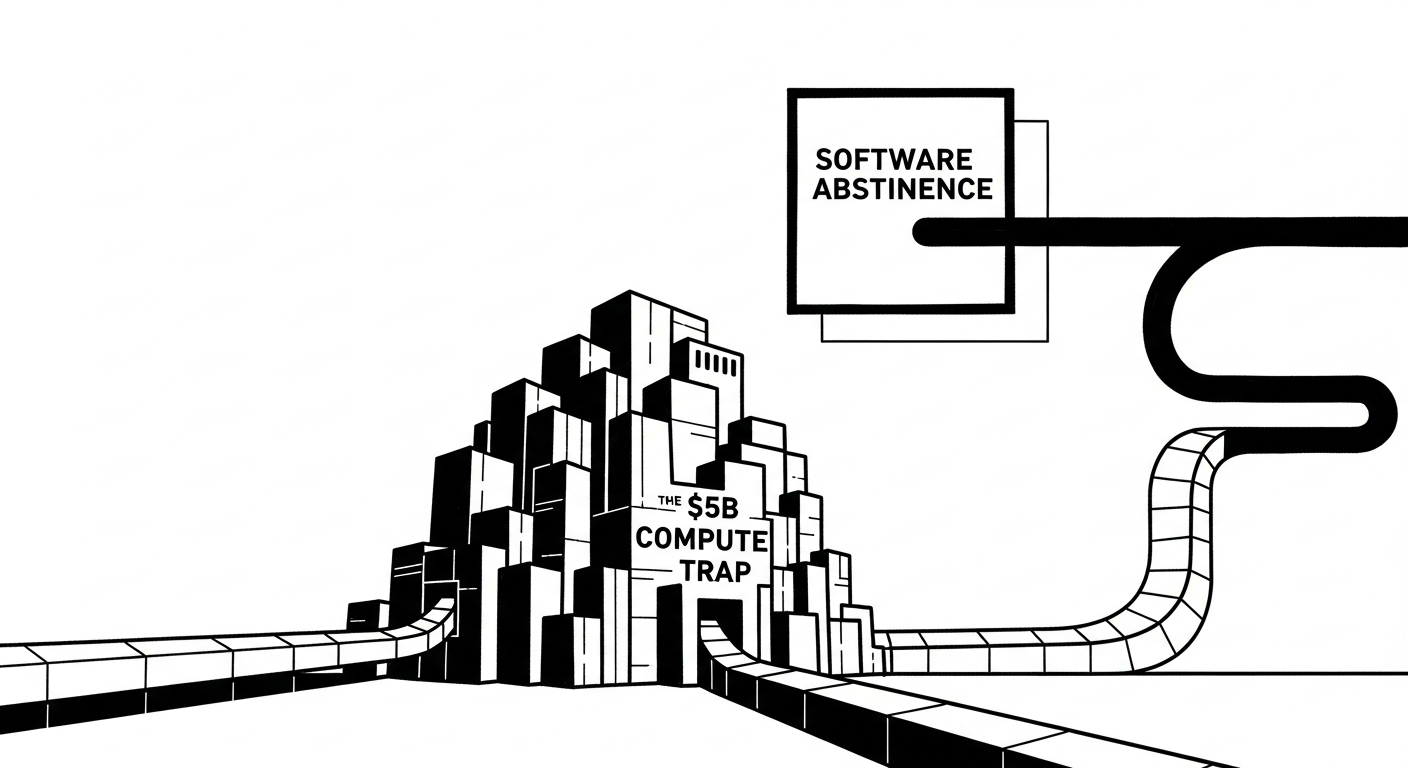
The news this week is dominated by two extremes: Anthropic signing a $5 billion deal for xAI's compute, and Cloudflare cutting 20% of its workforce. For those of us running a portfolio of 3-5 brands with a lean agent stack, these are two sides of the same coin. The era of growth at any cost is being replaced by a brutal focus on infrastructure efficiency. While the giants trade billions for 300MW of capacity, the indie operator’s edge remains the same: staying small, staying profitable, and refusing to overbuild.
Stop the Dependency Bloat
Xe Iaso recently suggested something that should be a core operating principle for every portfolio: software abstinence. The modern digital ecosystem is fragile. Between the GNU IFUNC vulnerability and the latest Next.js security release—which patched 13 vulnerabilities—the message is clear. Every new library you add to your monorepo is a liability you have to maintain on a Sunday night.
When you are running a portfolio, you don't have the luxury of a dedicated security team. You are the security team. The goal isn't to have the most sophisticated tech stack; it’s to have the most stable one. If a tool doesn't directly contribute to cash flow or significantly reduce the manual load on your agents, don't install it. Reliability is a feature that your customers actually pay for; the latest experimental framework usually isn't.
Guardrails Over Hype
We saw the risks of unmanaged automation play out in South Africa, where government officials were suspended after AI hallucinations found their way into official documents. This is a classic failure of human-in-the-loop (HITL) design. For an indie operator, the temptation is to let agents run wild to save time. But as we see, the reputational and operational cost of a hallucination in a production environment is far higher than the time saved by skipping a manual review step.
Instead of chasing the next frontier model, focus on hardening your existing stack. Vercel’s update to support JSON values in feature flags is a perfect example of a boring but useful improvement. It allows you to consolidate agent parameters—like temperature and max tokens—into a single configuration object. It’s about building better control planes, not just bigger engines.
The Efficiency Mandate
Cloudflare’s 20% workforce reduction is a reminder that even the biggest infrastructure providers are feeling the squeeze. For the solo studio-operator, this is a signal to audit your own overhead. Are you paying for 'enterprise' features you don't use? Are your cron jobs running more often than they need to?
Niching down, as Dave Snider points out, is often the best way to maintain these margins. By solving specific problems for a defined group, you can charge premium pricing without needing the massive scale that requires $5 billion compute deals. Keep the stack simple, keep the overhead low, and keep the human in the loop. That’s how you survive the hype cycle.
Read the full piece
Weekly Briefing
The studio briefing.
What we’re building across the portfolio, every Monday.
Written by
Founder, Total Ventures
Solo-founder building and operating a multi-brand product studio with AI agents. Writing about building, operating, and shipping.