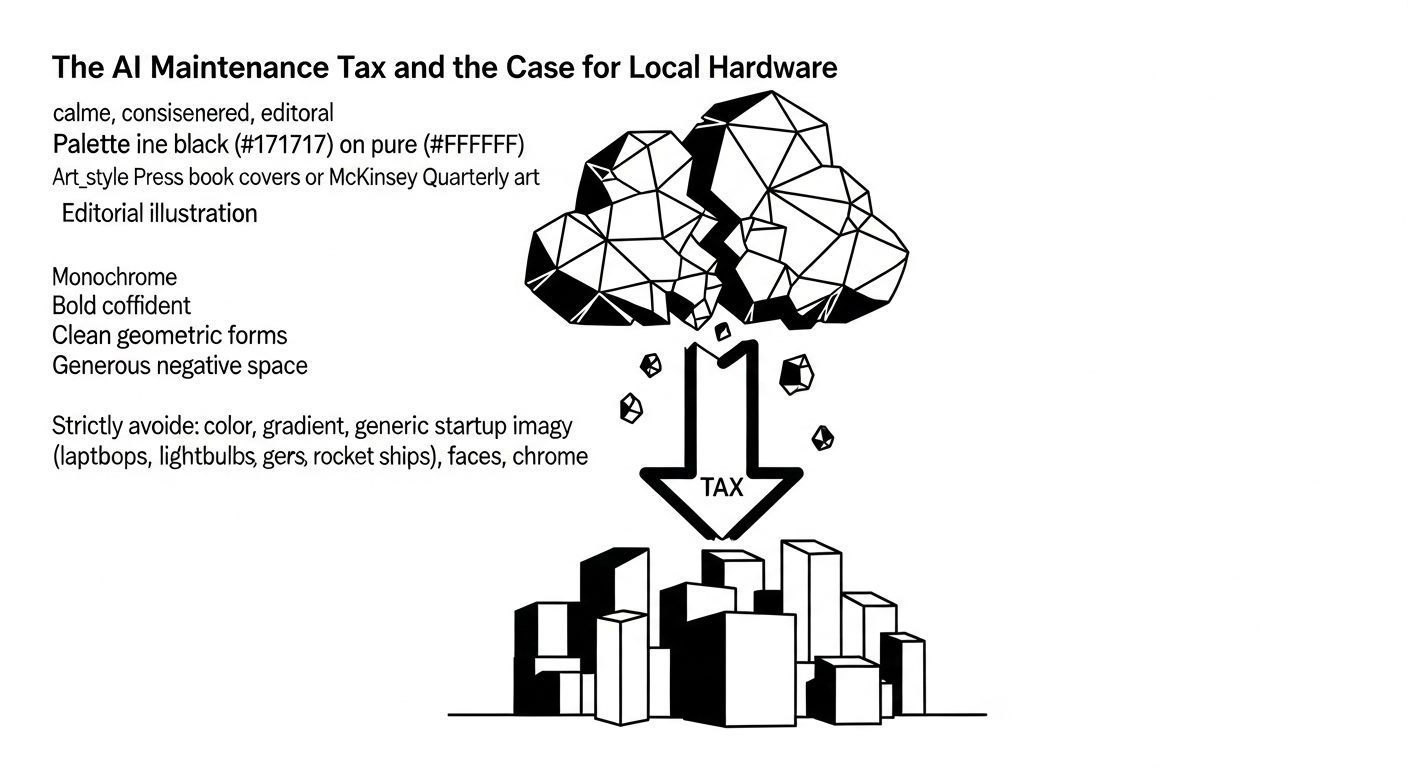
The novelty of agentic coding has officially worn off. Last year, the flex was how many features your agents could ship in a weekend. Today, the flex is how few of those features you actually had to rewrite. As a solo operator running multiple brands, I’m seeing a clear trend: the cost of AI-generated code isn't in the tokens; it’s in the long-tail maintenance and the cognitive overhead of managing 'black box' logic.
We’re entering the era of the maintenance tax. If your agent-augmented workflow is just dumping PRs into your repo without a rigorous validation layer, you aren't building an asset; you’re building a liability.
The High Cost of 'Cheap' Code
The developers of the PS3 emulator, RPCS3, recently had to ask the community to stop flooding them with AI-generated pull requests. Why? Because the 'contributions' were low-quality, introduced bugs, and lacked technical necessity. This is a warning for indie founders. When you use agents to scale your output, you risk overwhelming your own capacity to review and maintain that output.
James Shore recently argued that AI coding agents must be judged by their ability to reduce long-term maintenance costs. Speed is a vanity metric. If an agent writes a function in ten seconds that takes you two hours to debug because it used an obscure library or hallucinated a state machine, you lost money. We’re seeing a shift back to 'hand-written' logic for core architecture. You use the agent for the boilerplate and the unit tests, but you keep your hands on the wheel for the system design. This isn't being a Luddite; it’s being a profit-first realist.
Local Inference as a Profit Strategy
While the cloud providers are passing infrastructure costs down to ratepayers—look at the $2 billion surcharge Maryland residents are facing for out-of-state AI data centers—the smart move for the solo studio is to pull as much inference as possible onto local hardware.
Testing shows that an M4 chip with 24GB of memory is the current sweet spot for local development. It handles quantized 8B models like Llama 3.1 or Gemma 2 with enough fluidity to act as a real-time pair programmer without the API latency. When you run locally, you aren't just saving on token costs; you’re insulating your workflow from the 'walled garden' tendencies of hardware attestation and the volatility of cloud pricing.
Trust, Security, and the Plugin Trap
Our reliance on extensible tools is our biggest vulnerability. The recent report of an Obsidian plugin being used to deploy a remote access trojan is a reminder that every 'productivity booster' is a potential backdoor. For a portfolio operator, a single compromised plugin in your note-taking app or IDE can compromise every brand you own.
We’re moving toward a 'Verify Everything' stance. This is why tools like adamsreview are becoming essential; they use multi-agent ensembles to perform more rigorous, parallel audits of code before it ever hits a production branch. It’s better to have a slow, pedantic agent that finds one critical bug than a fast one that ships ten features and a security hole.
If you’re about to scale your agent stack, my advice is simple: optimize for legibility, keep your core logic manual, and invest in hardware that lets you work offline. The goal is to run a lean portfolio, not a high-speed technical debt factory.
Read the full piece
Weekly Briefing
The studio briefing.
What we’re building across the portfolio, every Monday.
Written by
Founder, Total Ventures
Solo-founder building and operating a multi-brand product studio with AI agents. Writing about building, operating, and shipping.