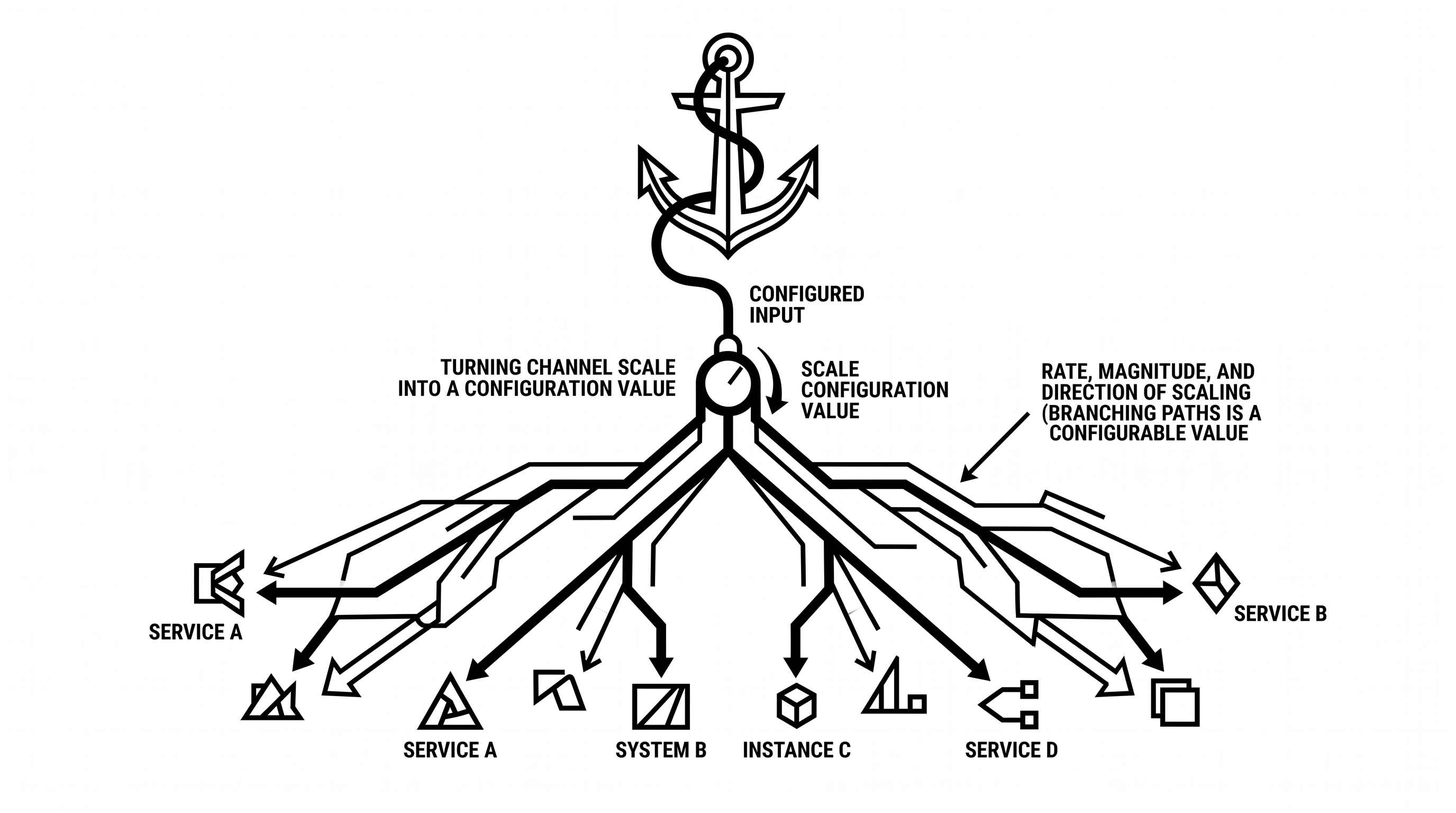
We route every published asset through a single daily markdown file stored in the project repository under content/anchors. That file carries the complete argument, the specific code or product details, and the structural headers for the day. Before it exists, no social queue is populated, no newsletter is formatted, and no captions are generated.
Most multi-channel strategies fail because they treat every platform as a distinct blank canvas requiring its own creative spark. A writer sits down to compose a LinkedIn post, shifts context to condense it for X, adjusts the tone for Threads, and then drafts a carousel caption for Instagram. By the time four channels are covered, the editorial effort has quadrupled, but the core idea has usually dissolved into four slightly different versions of generic advice.
The anchor and fan-out model replaces distinct creation steps with a strict structural hierarchy. One primary piece carries the complete weight of the day's thought. Every short-form asset produced that day is a constrained cut extracted directly from that source.
Defining the Anchor Piece
An anchor piece is not a brief or a list of bullet points. It is a fully realized, 800-word piece of prose that establishes a clear thesis, provides specific evidence, and arrives at a practical conclusion. It sits as the master document for the brand on that calendar date.
Because the anchor must fuel every downstream format, it has to be dense. A vague piece yields weak derivative posts. If the anchor contains three concrete technical choices, two specific trade-offs, and a measurable outcome, it provides enough material to supply half a dozen distinct social surfaces without repeating phrases or inventing filler.
Writing the anchor first enforces a high bar for depth. If an idea cannot sustain an 800-word piece grounded in concrete details, it is not ready to be fanned out across social channels. It gets dropped before any derivative work begins.
Constrained Cuts Across Surfaces
Once the anchor is written, fan-out is a deterministic process of extraction based on surface constraints. Every social network has hard boundaries defined by character limits, visual formats, and link handling. Instead of writing new copy for those surfaces, we apply constraints to the existing text of the anchor.
- Bluesky and X take a single sharp point from the piece, expressed in under 280 characters without context setup or introductory filler.
- Threads takes a slightly longer excerpt—up to 500 characters—giving room for a concrete detail alongside the core assertion.
- LinkedIn uses three paragraphs extracted from the anchor’s key argument, maintaining the technical depth while removing conversational asides.
- Instagram Carousels split five pull quotes directly out of the body headers and key sentences, letting typography carry the visual load while the caption supplies the surrounding context.
None of these cuts add new claims or invent new angles. They are strict slices of the anchor piece, shortened to fit the container they live in. If a surface requires a 300-character limit, the system extracts the strongest 250 characters of the anchor's core argument rather than asking a writer to summarize the whole article in a tweet.
Channel Count as Configuration
When daily output relies on constrained extraction rather than surface-specific ideation, adding a new platform changes from an operational hurdle into a config adjustment.
In a traditional model, expanding from two social channels to six requires either hiring more writers or burning out the ones you have. The work scales linearly with the number of destinations. In the anchor and fan-out model, the creative work occurs entirely at the anchor stage. The cost to produce content for six channels is functionally identical to the cost for two, because the input is always exactly one piece of written work.
A new platform target simply means defining a new set of extraction rules: maximum character length, link placement policy, and media formatting. The platform is added to the delivery pipeline's destination array. If a channel breaks, policy changes, or loses value, it is removed from the array without altering the core editorial workflow.
Depth Preserved at Scale
The real risk of publishing across multiple platforms daily is the gradual decay of substance. When team energy is divided across keeping eight different social feeds warm, the depth of each individual post drops toward zero. Brands end up posting empty questions, vague platitudes, and soundbites devoid of detail.
Anchoring the daily workflow around one deep piece flips that dynamic. All editorial energy is concentrated into making a single article sharp, accurate, and specific. The downstream cuts inherit that sharpness automatically because they are physical pieces of the original document.
A team running this system spends ninety percent of its time on the core technical idea and ten percent on extraction mechanics. The footprint on social media grows wider, but the signal stays grounded in the actual work being done.
Weekly Briefing
The studio briefing.
What we’re building across the portfolio, every Monday.
By subscribing, you agree to receive occasional studio updates from Total Ventures. No spam. Unsubscribe anytime. Privacy Policy
Written by
Founder, Total Ventures
Solo-founder building and operating a multi-brand product studio with AI agents. Writing about building, operating, and shipping.

