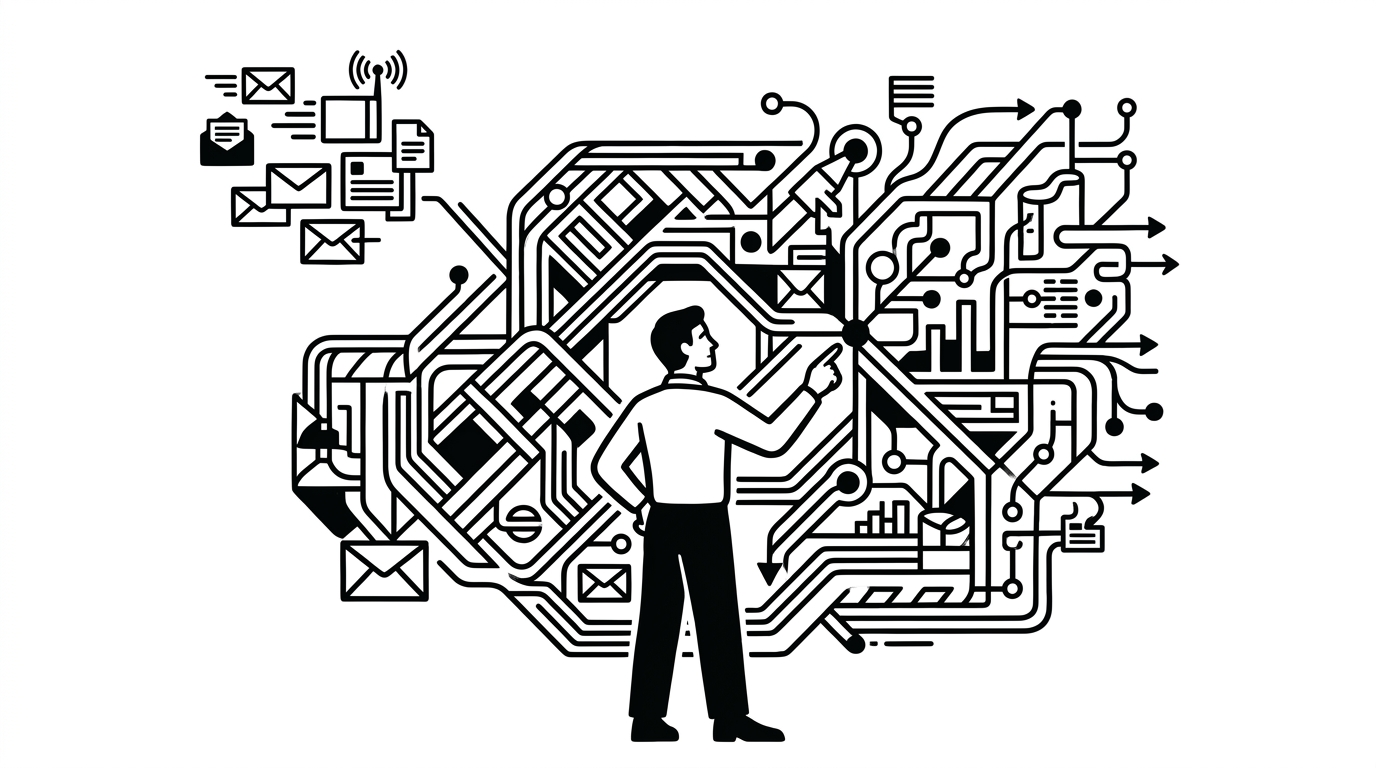
We pulled the transactional mail logs for a production web application running active promotional sends, and found that zero automated messages went out after a user completed their initial setup. The team was dedicating hours every week to writing copy, building templates, and scheduling campaign broadcasts. Meanwhile, the most critical window in a user's lifecycle—the minutes right after account creation—was handled by an unformatted system template from the authentication service.
This pattern shows up repeatedly in software products and store operations. The default instinct is to build a campaign calendar: product announcements on Tuesday, feature highlights on Thursday, sales over the weekend. But campaigns are temporary. They demand continuous labor, decay in relevance hours after landing, and treat every recipient as if they share the exact same context. Lifecycle triggers do the opposite. They run automatically, deliver at the precise moment of intent, and accumulate value over time.
The Three Anchor Moments
Before drafting another broadcast, map the three core events that shape user behavior: the initial signup, the completed transaction, and the silent lapse. Most systems have at least two of these paths sitting completely unconfigured or defaulting to raw framework outputs.
The signup event is often treated as a simple credential confirmation. A user registers, gets a link or a verification token, and silence follows. Yet signup is the point of highest interest. Someone has just explicitly opened their inbox to your application. Replacing a plain system confirmation with a three-part onboarding path—verifying access, explaining the immediate next step, and showing the core feature—changes early retention without adding recurring maintenance.
The Post-Purchase Vacuum
The second anchor is the purchase or primary conversion event. Payment is not the end of a transaction; it is the moment evaluation begins. If the only automated dispatch following a purchase is an invoice, you leave a wide gap between payment and actual product experience.
A structured post-purchase sequence resolves confusion before it turns into support tickets. It delivers clear setup instructions, sets expectations for delivery or provisioning, and introduces useful docs or features. For software products, this means guiding the user to their first meaningful outcome within twenty-four hours. For physical products, it means offering clear setup details while the order processes. When this trigger is absent, users flounder or default to support queues with predictable questions.
The Silent Lapse
The third anchor is the lapse, and it is routinely overlooked. Users rarely close accounts with a formal announcement. They stop logging in, skip a week of activity, or gradually drift away from the workflow.
If you wait until an account reaches ninety days of complete inactivity, re-engagement emails rarely work. The initial intent has dissolved. Mapping the lapse means pinpointing the precise window where non-usage becomes unusual. For an active software tool, that might be seven consecutive days without a core action. For an e-commerce platform, it might be thirty days past the usual reorder window.
An automated email triggered at that specific friction point—surfacing a useful feature update or offering direct help—carries far more weight than a broad win-back campaign sent to a cold list months later.
Audit Before Writing
Setting up these three triggers requires no new creative campaigns or complex strategy shifts. It requires an accurate map of your existing software events.
Start by listing every transactional endpoint in your backend services. Trace where those events route, what payloads they carry, and whether an email service provider listens to them. In many web applications, event hooks for account creation or subscription updates fire silently by default but never connect to a messaging pipeline.
Once the architecture is clear, evaluate every active trigger against three criteria: clarity, timing, and direct usefulness. A single message that guides a user to their next action is worth more than five promotional emails asking them to check a dashboard.
Fixing what already fires builds an automated baseline that works continuously. When those three core paths are built, every future campaign lands on a system that actually retains the audience you bring in.
Weekly Briefing
The studio briefing.
What we’re building across the portfolio, every Monday.
Written by
Founder, Total Ventures
Solo-founder building and operating a multi-brand product studio with AI agents. Writing about building, operating, and shipping.