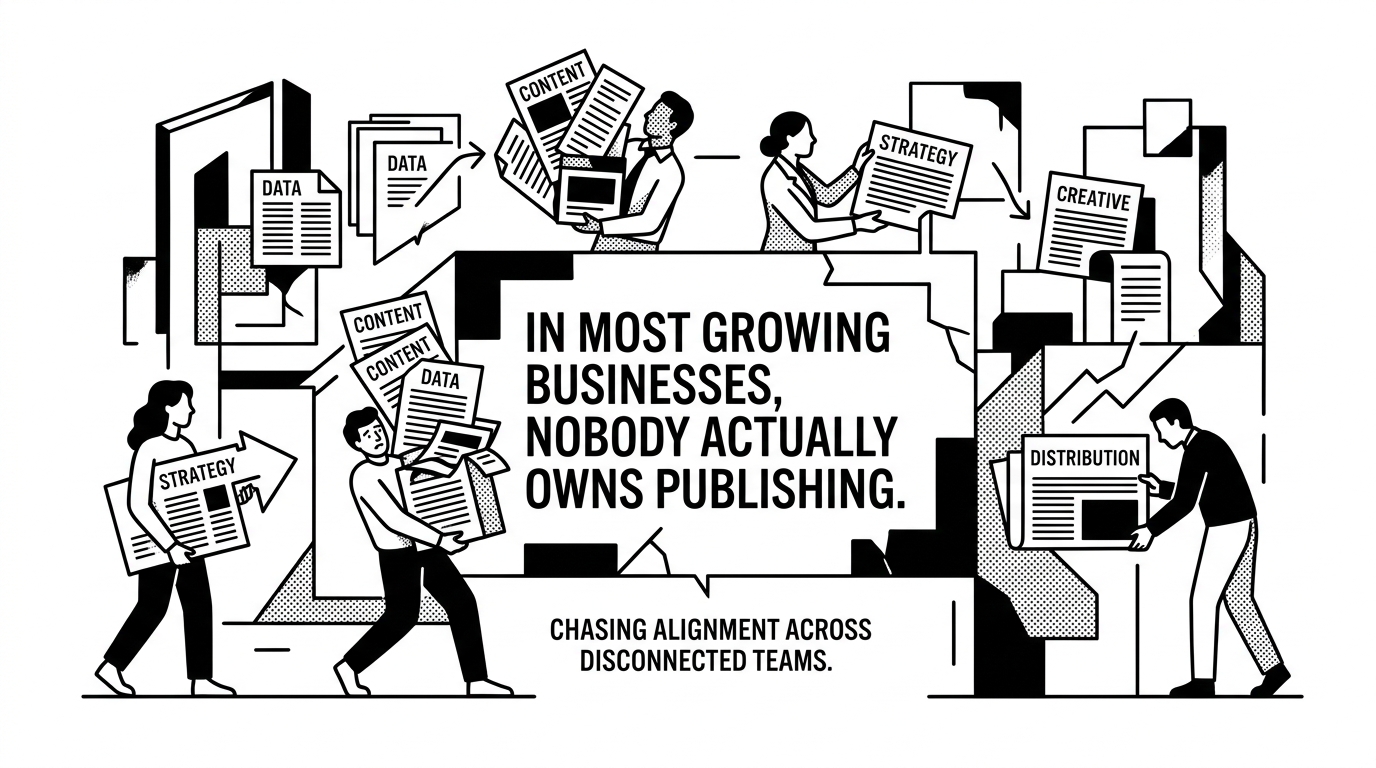
Last October, a software team published nothing for six weeks despite having forty-two finished drafts sitting in a shared Notion folder. The draft folder wasn't empty, the ideas were solid, and the team regularly agreed in weekly syncs that technical writing was critical for their growth.
When we looked closer at the bottleneck, the cause was clear. Editing and shipping those pieces was item number three on the head of marketing’s weekly checklist. Items number one and two were pipeline metrics and managing paid campaign performance. Whenever ad conversions dropped or sales requested a new slide deck, editing posts dropped off the schedule entirely.
This scenario plays out in almost every team that hasn't designated a dedicated publisher. Content gets assigned to a generalist marketer, a product manager, or a founder as an extra responsibility. On paper, they oversee the blog, the newsletter, and social updates. In practice, they handle urgent operational fires forty hours a week and try to write articles during tiny windows of downtime.
The third priority never happens
If a task sits third on someone's daily list, it almost never gets shipped. First priorities get done because the business hurts immediately if they don't—a broken billing flow, a missing ad creative, or an unserved customer ticket. Second priorities get done because people are actively following up in Slack. Third priorities are quiet. A draft sitting in review doesn't break a build or trigger a support alarm.
When a team notices their blog or newsletter hasn't updated in two months, the impulse is usually to rewrite the playbook. They bring in consultants, set up new content pillars, build fresh Notion templates, or test drafting tools.
None of those fixes work because none of them solve the real constraint. The constraint isn't a lack of tools, topic ideas, or strategic intent. The constraint is that no single human being wakes up on Tuesday morning with the explicit job of taking a rough draft and making it live.
Strategy changes don't fix delivery problems
When publishing belongs to everyone in principle, it belongs to nobody in practice. A software engineer writes a solid technical breakdown on Monday morning. They drop it into a channel for review. The product lead intends to read it, but gets pulled into a customer escalation. The engineer moves on to the next sprint task.
Three weeks later, the draft is cold. The feature it describes has already changed twice, the engineer has lost the context, and updating it feels like starting over from scratch. The draft gets quietly archived.
We often see companies spend considerable budget building a modern blog layout or hiring outside agency partners to map out a full year of publication topics. Six months after the kickoff meeting, they have published four pieces. The roadmap was thorough, but the execution path was blocked by everyday work that took precedence.
What real ownership looks like
Fixing a dead publishing cadence doesn't require hiring an entire editorial newsroom or spending months overhauling your brand strategy. It requires picking one person and giving them full ownership of the publishing line.
A real owner needs three practical boundaries:
First, final editorial authority. If an article is clear, accurate, and ready, the owner can publish it without waiting for four levels of management approval. Waiting for sign-offs from three executives who have full calendars is where good pieces go to die.
Second, direct access to the work. An effective editor doesn't sit in an isolation chamber trying to make up topics. They interview the engineers who solved a hard database problem, talk to support reps about recurring user confusion, and translate those internal realities into public articles.
Third, protection from task creep. If the person who runs publishing is also expected to run event sponsorships, field incoming sales requests, and redesign landing pages, publishing will sink right back to priority number three the moment work spikes.
The clarity of a single line of responsibility
When one person owns the output, the delivery cadence changes immediately. Drafts stop sitting in folders for months because someone's performance is measured specifically on getting them reviewed, polished, and shipped.
The writing itself gets sharper, too. An editor who handles the publishing pipeline every week develops a direct feel for what lands with readers and what feels like corporate fluff. They stop publishing generic announcements and start sharing real details about what was built and how it works.
You don't need a longer strategy document or a complex approval chain to build a consistent publication. You just need one person who owns the green light, and the space to press it every week.
Weekly Briefing
The studio briefing.
What we’re building across the portfolio, every Monday.
Written by
Founder, Total Ventures
Solo-founder building and operating a multi-brand product studio with AI agents. Writing about building, operating, and shipping.