When a SaaS team in Austin dropped $18,000 into Google Search ads last spring, 420 people clicked through and zero finished onboarding. The ads did exactly what they were bought to do: they brought real people with intent to the front door. The front door was just locked, the sign on the glass was hard to read, and the sign-up form asked for a credit card before showing what the software actually looked like.
The expensive search for traffic
Buying ads before a software product converts organically feels like progress because money is moving. You get dashboards with graphs, click-through percentages, and impression counts. It feels like momentum. But paid acquisition is an amplifier, not a converter. It takes whatever math you already have and multiplies it by volume.
If 2 out of 100 people who land on a site organically sign up, clear the onboarding screens, and use the product three times a week, putting paid traffic behind that page makes sense. You are paying to speed up a machine that already works. But if organic visitors leave after forty seconds without creating an account, buying ten thousand more visitors only means ten thousand more people leaving after forty seconds. You haven't built a growth engine; you've built an expensive way to measure confusion.
When paid acquisition actually works
Paid acquisition works when three specific things are already true in the product:
First, the onboarding path has zero friction. A new user lands, understands what the tool solves in five seconds, and reaches their first useful moment—a rendered report, a generated invoice, or a clean dashboard—in under two minutes.
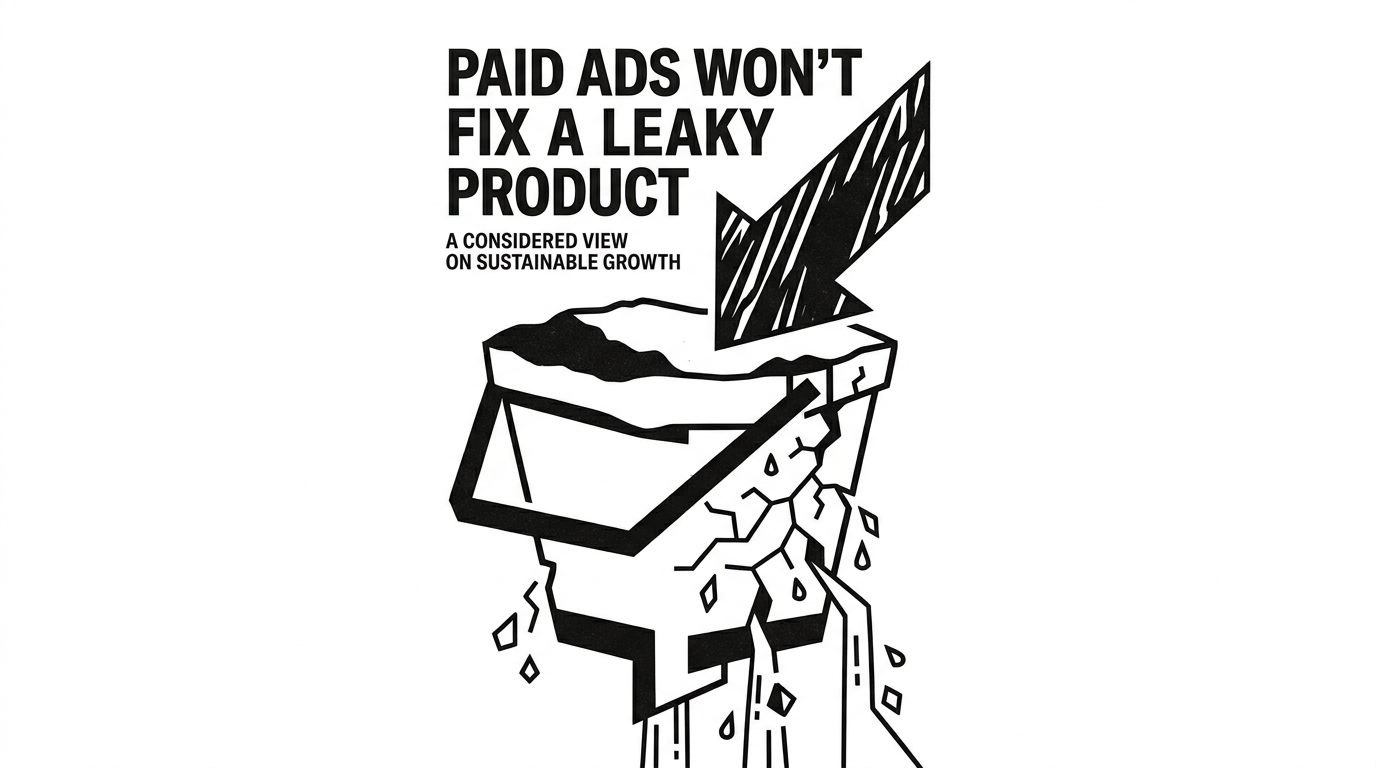
Second, retention is stable. Users who join stay long enough that customer value isn't a guess written on a napkin. If forty percent of account signups leave within thirty days, spending money to acquire more accounts is pouring water into a bucket with a hole in the bottom.
Third, the transition to paid tiers feels natural. People pay because the software saved them three hours of manual work or solved an annoying operational bottleneck, not because they were trapped by a sudden lock-screen wall. When those pieces are working, paid channels become simple arithmetic. You spend $40 to acquire an account that generates $200 over six months. That isn't marketing magic; it's distribution mechanics.
Buying proof versus buying throughput
There is a common temptation to run paid campaigns when you aren't sure if anyone actually wants what you built. The logic sounds reasonable: "We just need traffic to see if people like this."
That is buying proof, and it almost always fails. Paid traffic is cold traffic. People clicking an ad on Meta or LinkedIn have zero patience and no prior relationship with your team. They will not push through a clunky authentication flow, wait four seconds for a database query to return, or read three paragraphs of explanatory copy to figure out what you do.
If you need proof that a product solves a real problem, you don't buy ad placements. You put the software directly in front of twenty people who face that problem every day and watch where their cursor pauses. Organic users and warm introductions will tolerate a few rough edges and tell you what broke. Paid visitors will simply hit the back button and return to their feed.
Where the next dollar belongs
Before allocating budget to ad networks, look closely at the product's actual usage logs. Look at the database records between account creation and the first meaningful action. If half the people drop off at the team invite screen, fix the invite screen. If page load time on mobile sits at three seconds, cut the bundle size and optimize your assets.
Every week spent sharpening the product improves the yield of every future dollar spent on growth. Once the onboarding flow takes thirty seconds, the first value moment is instant, and active users stick around for months, turn on the ads. Until then, keep the money in the bank and focus on making software worth using.
Weekly Briefing
The studio briefing.
What we’re building across the portfolio, every Monday.
Written by
Founder, Total Ventures
Solo-founder building and operating a multi-brand product studio with AI agents. Writing about building, operating, and shipping.