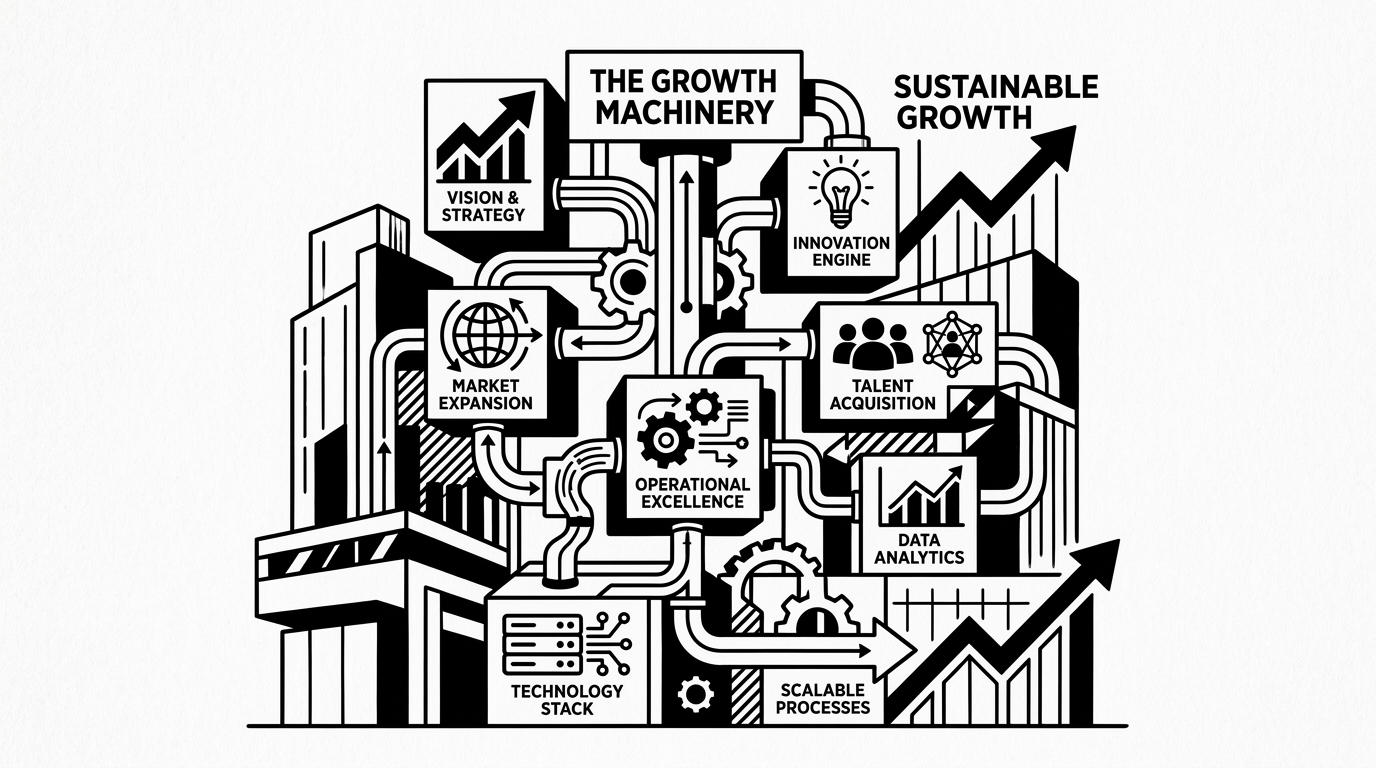
At the 2024 Adobe Summit, several growth leads noted that 40% of their creative output is now dedicated solely to testing variations for social algorithms that change every six weeks. This is the reality of the growth machinery. It is not a single campaign or a clever tagline, but a series of interconnected pipes—content, email, social, ads, funnels, and analytics—that either work together to move a business forward or leak cash until the owner steps in to patch them. For a business that has moved past its first million in revenue, the question is no longer "do we do this?" but "how do we run this without it becoming a second full-time job?"
The Attention Engine and the Social Trap
Most owners start by treating social media as a megaphone, but it functions more like a high-maintenance engine. When you hire an agency to "do social," you are often buying a package of twelve posts a month and a monthly report. The friction starts when the agency doesn't understand the nuance of the product, leading to "engagement" that feels like a stranger wearing your clothes.
The alternative is the in-house hire, usually a talented generalist who can capture the soul of the brand but eventually hits a ceiling on production volume or technical strategy. The machinery requires both: the specific, "lived-in" voice of the company and the rigorous, data-driven cadence of a distribution system. If you cannot produce three variations of a video hook to see which one keeps a viewer past the three-second mark, you aren't running a social strategy; you are just posting into the wind.
The Plumbing of Email and Funnels
Email is the only part of the machinery you actually own, yet it is often the most neglected. We see businesses with $50,000 monthly ad spends sending the same generic "Welcome" email they wrote three years ago. A healthy funnel is a series of if-then statements: if a customer looks at a specific category twice but doesn't buy, they should receive a different sequence than the person who just signed up for a discount code.
Building this in-house requires a rare mix of a copywriter who can sell and a technician who understands liquid tags and deliverability. Agencies often charge a premium for the initial setup but fail to iterate on the data. The machinery approach treats email as a living system. It means looking at the 22% open rate on a cart abandonment sequence and testing whether a plain-text email from the founder outperforms a glossy HTML template. Small shifts in these numbers—moving a conversion rate from 1.5% to 2.1%—often represent more net profit than a 20% increase in top-of-funnel traffic.
The Reality of Ads and Analytics
Since the release of iOS 14.5, the "set it and forget it" era of Meta and Google ads has ended. The signal is noisier, and the platform's own reporting is often optimistic by a margin of 15% or more. When you look at your dashboard and see a 4x Return on Ad Spend (ROAS), but your bank account shows a different story, the analytics machinery is broken.
The challenge for an owner is deciding who owns the "truth." An ad agency wants to show that their creative is working. An email tool wants to claim credit for every sale that touched an inbox. A robust system uses a third-party source of truth—server-side tracking or a dedicated attribution model—that reconciles these claims against the actual revenue in Stripe or Shopify. Without this, you are making scaling decisions based on ghost numbers.
Choosing the Operating Model
The decision to build in-house, hire an agency, or adopt an external system usually comes down to where the bottleneck sits.
In-house teams are best for "soul"—the high-context content and deep customer relationships that an outsider can't replicate. Agencies are best for "sprints"—launching a new channel or building a complex technical integration that your team doesn't have the bandwidth to learn. Systems are for "scale." A system-first approach means you aren't hiring people to figure out what to do; you are hiring them to run a proven process that already has the tracking, templates, and feedback loops built-in.
The goal is to move the owner from the role of "Chief Mechanic" to "Pilot." You should be able to look at a single dashboard on a Tuesday morning and see exactly which part of the machinery is stalling. If the cost to acquire a customer jumps by $10, you need to know if it’s because the ad creative is stale, the landing page is loading 500ms slower than last week, or the email follow-up sequence stopped firing.
The most expensive way to grow is to treat these departments as silos. When the person running your ads doesn't talk to the person writing your emails, and neither of them can see the actual profit margins in your analytics, you aren't building a machine. You are just paying for a collection of parts that don't fit together. The machinery works when the data from a failed ad informs the next email subject line, and the feedback from a customer support ticket changes the headline on the landing page. Profit lives in the connections between the parts.
Weekly Briefing
The studio briefing.
What we’re building across the portfolio, every Monday.
Written by
Founder, Total Ventures
Solo-founder building and operating a multi-brand product studio with AI agents. Writing about building, operating, and shipping.