In March, a developer tool team pushed four technical guides to their Astro blog, followed by six weeks of silence when their primary writer took parental leave.
The repository was sitting right there. The publishing pipeline worked through GitHub Actions, the staging links generated clean previews in seconds, and the content backlog listed a dozen drafted topics in Notion. Yet without a single human pulling those Markdown files into line, the whole publishing schedule froze.
When software teams calculate the cost of in-house content, the math usually stops at payroll. You tally salary, health insurance, software licenses, and hardware. That total feels predictable. You put a line item on the budget sheet, assign a desk, and assume your publication schedule is settled for the year.
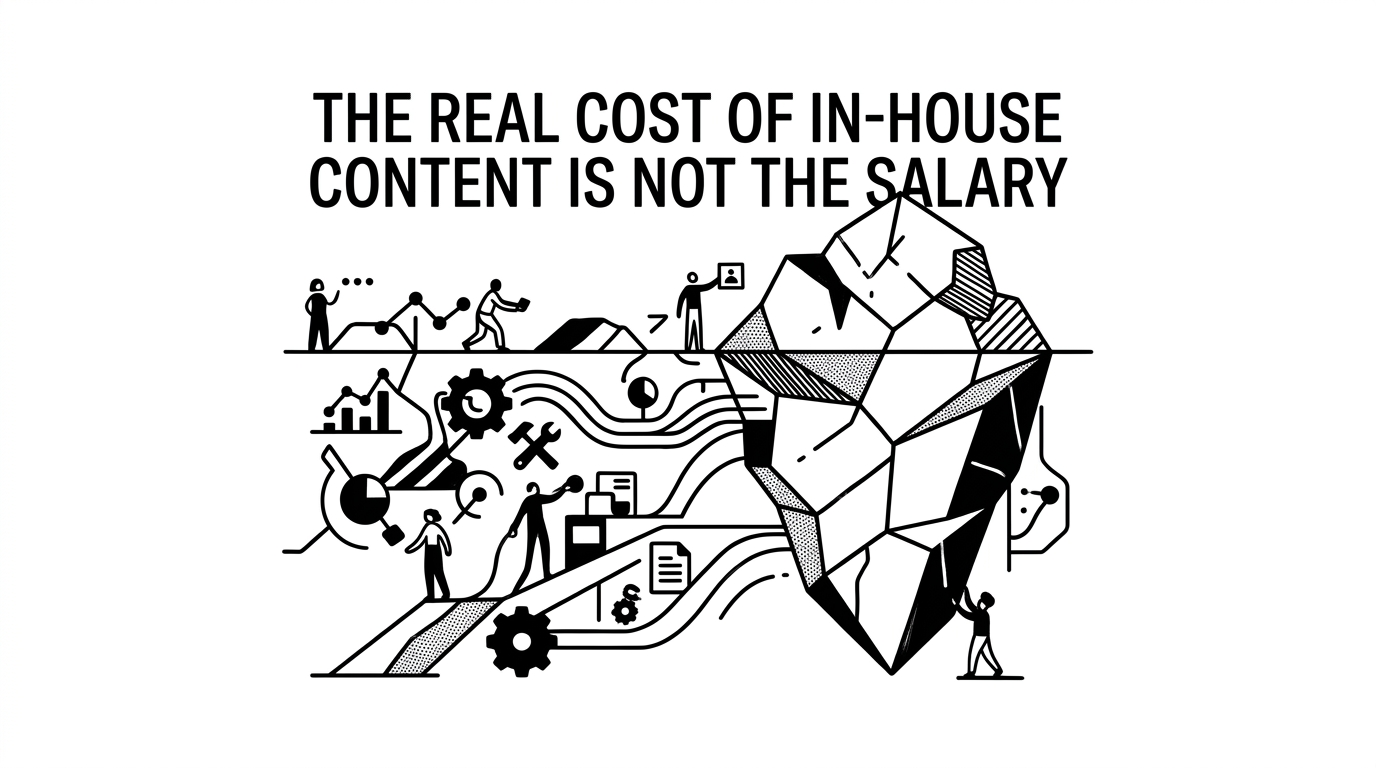
The real bill looks very different once you track output across twelve months. The largest expense isn't the salary paid every two weeks. It's the silent month where nothing goes live because your writer was pulled into a product launch, caught a flu, or spent three days editing microcopy for an app release.
The Swiss Army knife trap
In-house writers rarely get to write. In most software studios, the person brought on to produce deep technical essays ends up serving as the internal copy desk for every department.
On Monday, they start research for a long-form breakdown. By Tuesday afternoon, the product team needs help rewriting error messages for an onboarding flow. On Wednesday, sales needs three outbound templates edited for a release campaign. By Friday, the article draft is still sitting half-finished, and the team agrees to push it to next week.
This constant context-switching isn't a failure of personal discipline. It's an architecture flaw. When you hire one person to handle strategy, research, drafting, editing, and CMS formatting, you haven't built a content department. You've created a single point of failure with a keyboard.
The moment that person steps away, your media engine stops entirely. Traffic drops, search index crawl rates slow down, and the momentum built over six months of regular publishing evaporates.
Consistency is an engineering problem
Software engineering teams understand redundancy. You wouldn't run a production database without failover replicas, automated backups, and clear deployment scripts. You wouldn't rely on a single engineer manually running commands from a local terminal every time a production deploy happens.
Yet companies run their media channels on that exact model. They treat content as a personal habit—something that happens when a writer gets a quiet afternoon with enough focus—rather than a repeatable workflow.
When you treat publishing as an operations problem, the focus shifts from individual effort to pipeline reliability:
- Decoupled research: Outlines and interview notes live in structured Notion templates before drafting begins, so anyone on the team can pick up a topic without starting from scratch.
- Asynchronous review: Technical fact-checking and line edits happen in pull requests rather than live meetings that break creative focus.
- Batched queues: Written pieces are staged weeks ahead in GitHub, so a period of illness or holiday creates zero disruption on the public feed.
- Separated roles: Technical research, drafting, copyediting, and publishing are handled as distinct steps rather than a multi-hat burden placed on one person.
When these pieces exist as an operational system, publishing becomes modular. The goal isn't to churn out endless noise; it's to guarantee that thoughtful software writing reaches readers every week without requiring someone to work nights.
The true cost of interruption
Restarting a stalled publication engine costs far more than maintaining an active one. When a blog goes dark for six weeks, you don't just lose those six weeks of distribution. You lose subscriber trust, search relevance, and the internal momentum required to start writing again.
A steady publishing cadence builds confidence across the entire studio. When engineering sees write-ups go live every Tuesday like clockwork, they share raw release notes and architectural decisions more freely. When product leads see case studies published on schedule, they feed customer feedback into the queue.
The moment that cadence breaks, internal momentum stops. Team members stop sending notes because they assume the blog is neglected. Rebuilding that internal flywheel takes months—often requiring more effort than setting up the initial publication workflow.
Building for operational resilience
If your publishing output depends on whether one person has an unblocked calendar this week, you don't have a content strategy. You have an operational bottleneck.
Individual talent produces brilliant standalone pieces, but resilient operational systems deliver steady growth. Whether you draft internally or work with an external studio team, the publishing pipeline must exist outside of any single person's calendar.
When you decouple output from individual availability, consistency stops being a weekly emergency. A writer taking three weeks off doesn't result in an empty RSS feed—it just means the next four posts deploy automatically on schedule.
Weekly Briefing
The studio briefing.
What we’re building across the portfolio, every Monday.
Written by
Founder, Total Ventures
Solo-founder building and operating a multi-brand product studio with AI agents. Writing about building, operating, and shipping.