At Buffer, the content team once calculated that a single blog post required 12 hours of manual coordination across four different tools. This wasn't the time spent writing or researching; it was the time spent moving a card from one column to another, emailing a freelancer, checking a calendar, and manually uploading a file to a CMS. It was the cost of keeping the lights on. Most companies treat content as a creative problem, but once you scale past one post a month, it becomes a logistical one.
The $140,000 content manager
When a business decides to bring content in-house, they usually start with a hire. A mid-weight content lead in a major city often commands a salary of $110,000. When you add the standard 20% for benefits and payroll taxes, plus the $15,000 a year for a stack of SEO tools, project management seats, and stock assets, the baseline is $147,000.
This person is hired to be a strategist and a writer, but they often spend 40% of their week acting as a traffic controller. They are the human database who knows that the draft for the case study is in a specific folder and that the designer needs a reminder every Thursday. The business isn't just paying for content; it’s paying for the cognitive load of one person keeping the entire machine in their head. The moment that person takes a vacation or moves to a new role, the machine stops. The cost of an in-house hire is high, but the cost of the "hero dependency" they create is higher.
The agency middleware tax
The common alternative is to outsource to an agency. On paper, a $5,000 monthly retainer looks more efficient than a full-time salary. You get access to a team, a process, and a predictable output. However, agencies operate on billable hours, and a significant portion of that retainer is spent on "account management"—the time it takes for them to tell you what they’re doing.
If an agency spends four hours a month on status calls and another six hours on email updates and reporting, you are losing 20% of your budget to middleware. You are paying a premium for the agency to remember things for you. The work itself—the research, the interviews, the actual writing—is often a fraction of the total invoice. For many owners, the agency isn't a content solution; it’s an expensive way to buy back the mental energy of managing a calendar. It works as long as the checks clear, but it rarely builds any lasting operational equity for the brand.
The fragility of manual systems
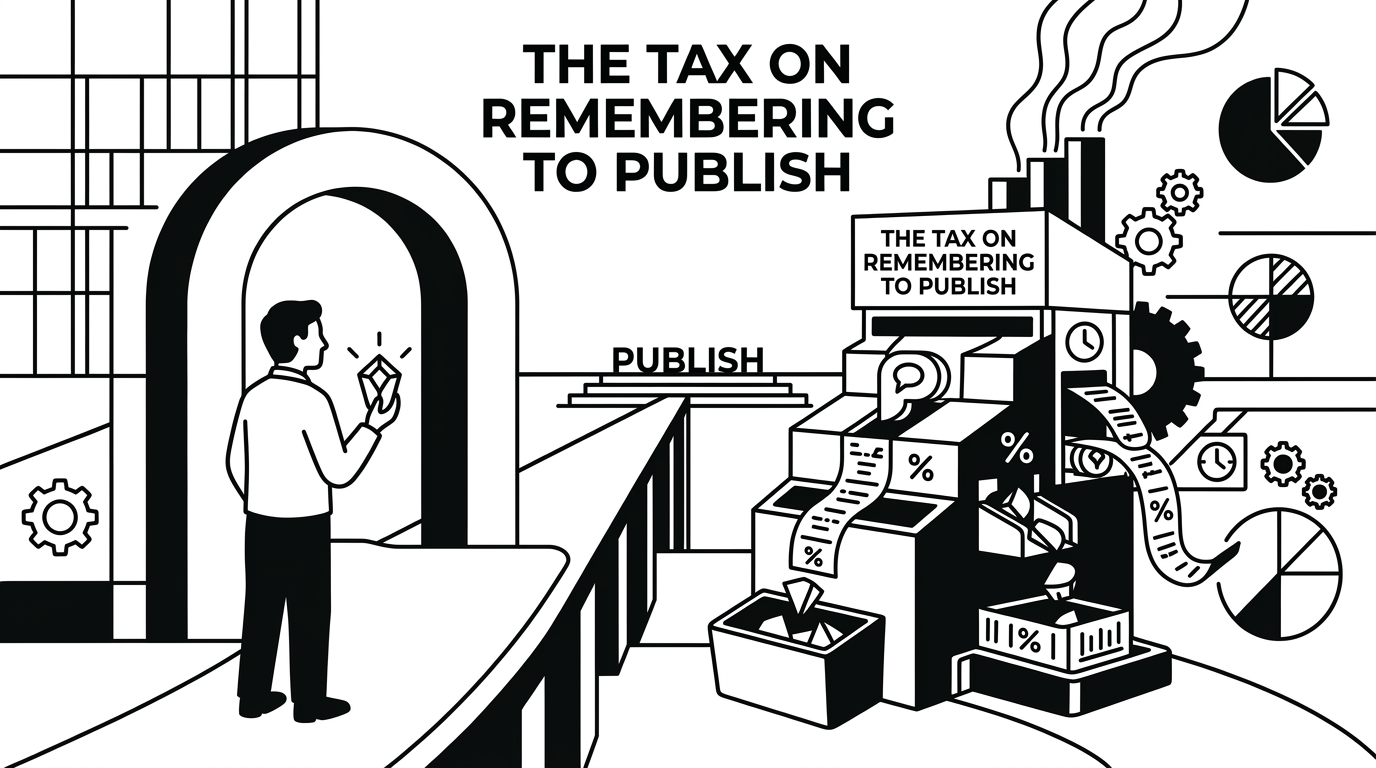
The most common way content operations fail isn't a lack of ideas or a lack of talent. It’s the "remembering tax." This is the invisible friction that occurs when every step of a process requires a human to initiate it. If the editor has to remember to notify the developer to update the blog template, or the founder has to remember to approve a draft on a Tuesday morning, the system is fragile.
We’ve seen this happen in teams of five and teams of fifty. When publishing relies on memory, it becomes a chore that gets pushed to the bottom of the list during busy weeks. If a product launch happens or a crisis occurs, the content operation is the first thing to break. This is because the operation was never a system; it was just a series of habits. A real system doesn't need to be "remembered" because the state of the work dictates what happens next. If a draft is marked "complete," the system should automatically move it to the next stage, notify the right person, and prepare the assets.
What we learned about systematization
In building software and running our own publishing tracks, what we learned is that the most resilient operations are those that treat content like a manufacturing line rather than a series of one-off projects. This means moving away from "who is doing this?" to "what happens next?"
A systematized approach focuses on the "state" of a piece of content. When the operation is built into the infrastructure—using database-driven calendars and automated triggers—the cost of coordination drops toward zero. You stop paying for a manager to check if a post is ready and start paying for the work itself. In this model, the owner’s role shifts from "remembering to publish" to "approving the quality."
When you remove the manual coordination, you also remove the emotional weight of the task. Publishing stops being a thing you have to "get through" and starts being a predictable output of the business. The goal isn't to remove the humans from the process, but to remove the parts of the process that humans are objectively bad at: repetitive scheduling and cross-platform syncing.
The cost of the silence
The true cost of an operation is best measured by what happens when you stop looking at it. If you step away from your content for a month and your blog becomes a ghost town, your operation was built on labor, not systems. You were paying for a person’s attention, which is the most expensive and least scalable resource in a company.
A systematized operation, whether run in-house or through a partner who provides the infrastructure, should have a "decay rate." It should be able to run on its own momentum for weeks at a time because the schedule is set and the triggers are automated. The difference between a $150,000-a-year payroll and a high-efficiency system is the difference between owning a job and owning an asset.
The final cost of a manual operation is the silence that follows the moment the owner looks away.
Weekly Briefing
The studio briefing.
What we’re building across the portfolio, every Monday.
Written by
Founder, Total Ventures
Solo-founder building and operating a multi-brand product studio with AI agents. Writing about building, operating, and shipping.