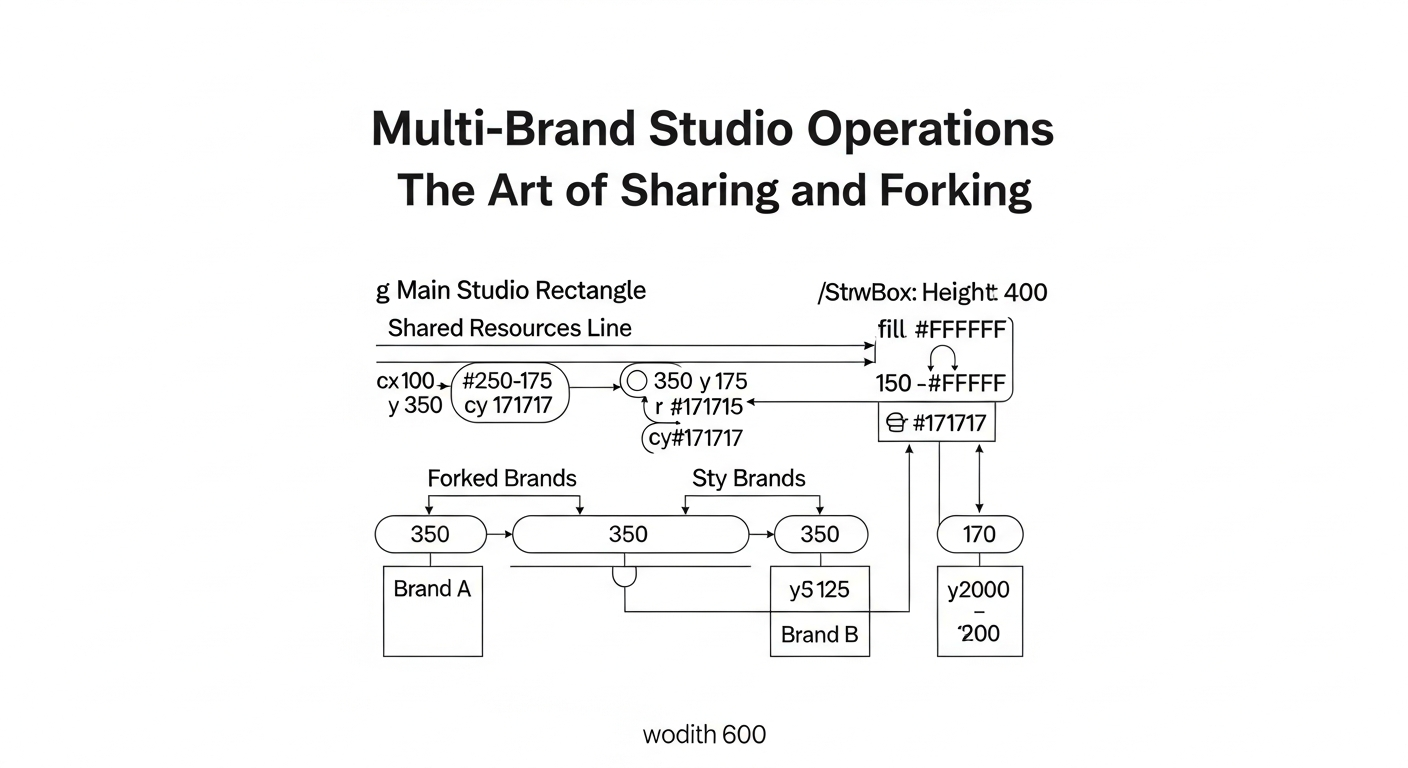
Building one software product is a feat of endurance. Building five at once, each with its own identity, user base, and roadmap, is a different sport entirely. When you move into the territory of multi-brand studio operations, the primary challenge isn't just writing code—it’s managing the gravity of your own infrastructure.
At a certain point, every studio founder asks the same question: Do we build every new product from scratch, or do we build a 'platform' that powers everything?
If you build from scratch every time, you waste months on the same boring plumbing—authentication, billing, transactional emails, and basic layout. If you build a rigid internal platform, you eventually find yourself fighting your own abstractions when a new product needs to do something slightly different.
Here is what we have learned about finding the middle ground.
The Gravity of the Shared Stack
In the early days of multi-brand studio operations, the instinct is to share everything. It feels efficient. You have one database cluster, one main API, and one component library. This works beautifully for the first two products. By the fifth, the weight of that shared infrastructure starts to pull back on your speed.
We’ve found that the most effective shared stacks are those that focus on the 'boring' parts of the business. These are the utilities that don't define the product’s value but are required for it to exist.
We look at sharing three specific layers:
- The Identity Layer: A single way to handle users across the studio. This allows for a 'studio account' experience where a user can move between your products seamlessly.
- The Transactional Layer: A unified approach to how we handle payments and subscriptions. We use a single logic flow for how a user upgrades or cancels, even if the price points differ between brands.
- The Deployment Pipeline: The way code gets from a developer's machine to a live URL should be identical across every brand.
By standardizing these, we ensure that when we start a new project, we aren't spending the first three weeks setting up environments. We are building the actual product.
When to Fork: The Cost of Sameness
Efficiency is a trap if it kills the soul of a product. While the plumbing should be shared, the user experience often shouldn't be. This is where many multi-brand studio operations stumble. They try to force a single design system onto five different brands to save time, resulting in a suite of products that all feel like the same gray SaaS template.
We choose to fork—or create unique instances—when the shared logic starts to require 'if' statements.
If you find yourself writing code that says if (brand === 'ProductA') { doThis() } else { doThat() }, you have a leak in your abstraction. That is the moment to fork that specific component or logic.
Forcing a shared component to handle five different edge cases makes the code brittle and hard to test. It’s often better to copy the component into the new brand’s repository and let it evolve independently. You lose the 'update once, fix everywhere' benefit, but you gain the 'change this without breaking four other businesses' safety net. In the long run, the latter is more valuable for velocity.
Designing for Portability
One of the most overlooked aspects of multi-brand studio operations is the 'exit' or the 'spin-off.'
If you build five brands on one giant, interconnected monolith, you have effectively created a five-headed monster. If a buyer comes along and wants to purchase just one of those brands, or if you decide to bring on a dedicated team for one specific product, extracting it becomes a technical nightmare.
We try to build with 'logical isolation.' This means that while we might use the same hosting provider or the same general architectural patterns, the data for each brand lives in its own container or schema. The file storage is separate. The API keys are unique.
This approach requires a bit more setup on day one, but it ensures that each brand is an asset that can stand on its own two feet. It makes the studio a portfolio of independent businesses rather than one big, messy ball of code.
The Human Element of Multi-Brand Operations
Beyond the code, the hardest part of running multiple brands is the context switching. Your brain isn't a multi-threaded processor; it’s a high-latency engine that needs time to warm up.
In our operations, we try to group work by 'mode' rather than by 'brand.' Instead of spending Monday on Brand A and Tuesday on Brand B, we might spend Monday morning on 'Infrastructure' across all brands, and Tuesday on 'Feature Development' for the highest priority project.
We also lean heavily on documentation that lives with the code. Because we are jumping between different domains, we can't rely on memory. We document the 'why' behind decisions so that when we return to a brand after three weeks of focusing elsewhere, we can pick up the thread in minutes, not hours.
Building for the Long Haul
Multi-brand studio operations are a marathon of discipline. It is tempting to take shortcuts when you’re excited about a new idea, but those shortcuts compound.
If you’re just starting to scale from one product to many, start by identifying your 'Studio Core'—the 20% of code that every product you ever build will need. Build that well, keep it simple, and keep it separate from the unique magic of your individual brands.
We’ve found that the best products come from having the freedom to experiment within a stable environment. By getting the operations right, we give ourselves the room to focus on what actually matters: building software worth using.
See what we've made — totalventures.io
Weekly Briefing
The studio briefing.
What we’re building across the portfolio, every Monday.
Written by
Founder, Total Ventures
Solo-founder building and operating a multi-brand product studio with AI agents. Writing about building, operating, and shipping.