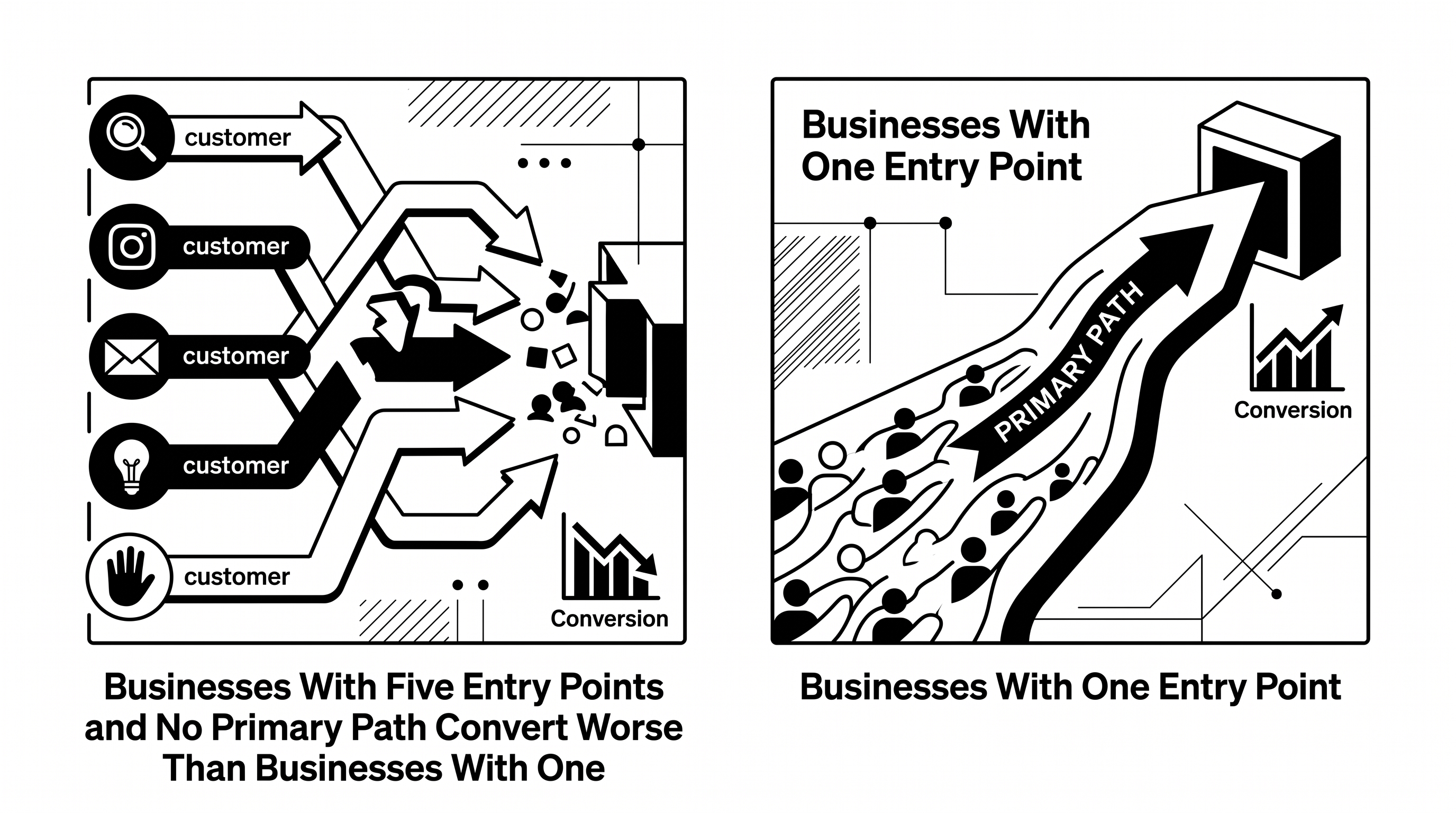
A software business removed four competing action buttons from their homepage banner, leaving only a direct line to start a team account. Within three weeks, completed account creations increased by twenty-four percent while bounce rates dropped across paid landing channels.
The change did not require a new design system, a rewritten copy deck, or a re-engineered backend. It required a decision about how a visitor is supposed to become a customer.
The Cost of Undecided Navigation
When a homepage offers a visitor five equal choices—"Start Free Trial," "Schedule a Demo," "Watch the Video," "Talk to Sales," and "Explore the API"—it looks like hospitality. It feels like catering to every possible audience segment that might land on the page.
In practice, equal choices create immediate friction. A visitor landing on the page is forced to evaluate five different verbs before they have even evaluated the product. They must decide whether they are a "trial" person or a "demo" person, whether their team size warrants talking to sales, or whether watching a two-minute video will save them from making an incorrect choice.
Every option presented at the top level asks the user to do internal categorization work for the vendor. When faced with that effort, most visitors take the path of lowest immediate resistance: they close the tab.
Why Multiple Paths Keep Getting Built
Multiple entry points are rarely designed for the person visiting the site. They are built to resolve internal disagreement.
Sales wants immediate leads routed directly to calendar slots. Product wants unassisted self-serve signups to feed usage metrics. Content teams want video views. Enterprise account managers want custom forms to filter for company size. When a company cannot decide which of those motions represents its real engine, all four departments get a button in the hero section.
Spreading choices across the header and hero area allows internal stakeholders to avoid choosing a primary go-to-market motion. But shifting that operational ambiguity onto the user lowers overall conversion across every single pathway. A site that attempts to support five primary journeys ends up supporting none of them well.
The Friction of Choice
Consider the mechanical difference between a single guided route and a fork with five prongs.
When a page offers one primary action, the user's brain processes a simple binary decision: yes or no. If the value proposition resonates, they click the button and enter the workflow. The friction is confined to evaluating the product's pitch.
When a page offers five primary actions, the binary decision breaks down into a comparative matrix. The user must compare "Start Free Trial" against "Schedule a Demo." They wonder if the trial requires a credit card, if the demo will be a high-pressure sales pitch, or if the video contains information not listed on the page. The mental energy that should be spent understanding the product is spent navigating the vendor's internal organizational chart.
A single path builds momentum. Multiple equal paths disrupt it.
Establishing the Primary Line
Fixing a fragmented customer journey begins with identifying the one path that produces the highest long-term retention.
For most early and mid-stage software products, one motion consistently outperforms the rest. Either self-serve trial users retain better after touching the product directly, or qualified leads convert faster after a short walk-through with an account manager.
Once that primary line is identified, every other entry point must step back into a supporting role:
- Reserve the hero area for a single primary action. One button, one clear promise, one destination.
- Demote secondary paths below the fold. If a prospect genuinely needs a sales conversation or technical documentation, make it available further down the page where context has been established.
- Align onboarding to the chosen entry point. A self-serve path should lead straight to an empty state ready for input, not a tour prompt asking them to schedule a call.
Eliminating competing options does not mean shutting out secondary buyers. It means giving the vast majority of visitors a clear, confident direction to walk in.
What Happens When You Commit
When a business picks its primary path and commits to it, every downstream metric becomes clearer. The engineering team builds onboarding flows for one specific journey rather than maintaining three edge-case setups. The marketing team writes copy that leads to a single concrete outcome.
Choosing a path is uncomfortable because it feels like turning away edge cases. But a focused customer journey built around one clear doorway will always outconvert a wall with five half-open doors.
Weekly Briefing
The studio briefing.
What we’re building across the portfolio, every Monday.
By subscribing, you agree to receive occasional studio updates from Total Ventures. No spam. Unsubscribe anytime. Privacy Policy
Written by
Founder, Total Ventures
Solo-founder building and operating a multi-brand product studio with AI agents. Writing about building, operating, and shipping.


